The dining room, pendant and table
A well-dimensioned pendant centres the entire room
A dining table without a dedicated pendant looks anonymous. Well proportioned, a pendant anchors the room immediately.

How do you choose and hang the pendant above the table?
Aim for a diameter of one third to half the table's length, and drop the bottom of the pendant to 75-85 cm above the tabletop. Use a warm bulb (2700-3000 K) on a dimmer, 400-600 lumens, and centre the pendant on the table, not the room.
§ 01The principle
The pendant above the dining table is the central element of any dining room. Well chosen and well positioned, it immediately creates the "set table" atmosphere, focuses the diners, and visually structures the room.
Three criteria for success.
Dimension. The pendant is one third to half the width of the table. For a table of 1.80 m × 0.90 m, pendant of 60-90 cm in diameter. For a table of 2.40 m, pendant of 80-120 cm.
Height. The bottom of the pendant is 75-85 cm above the top of the table, that is around 1.55-1.60 m from the floor for a table at 75 cm. See also rule 02.6 on the pendant above the table.
Light. Bulb with dimmer, 2700-3000 K, 400-600 lumens. Warm, intimate light, focused on the table.

Diameter = 1/3 to 1/2 the length of the table · Bottom at 75-85 cm from the top · Warm light with dimmer
Three measurements, an anchored room.
§ 02Putting it into practice
Choosing the pendant according to style.
Industrial or contemporary pendant. Matt black metal, patinated brass, pared-back lines. Brands such as Hay, Muuto, Tom Dixon, Vitra. Contemporary and graphic effect.
Pendant in rattan or natural materials. Warm and bohemian effect. Brands such as Tine K Home, Ay Illuminate, Bloomingville.
Classical pendant in glass or crystal. More formal effect. Reserved for classical interiors or contemporary ones with an antique echo.
Multiple pendant. For very long tables (2.40 m and over), two or three identical pendants spaced above the table. Distance between each, 60-80 cm.
Choosing the bulb.
2700 K (very warm white). Candlelit effect, intimate, perfect for dinners. This is the recommended choice.
3000 K (warm white). More neutral, versatile. To choose if you also use the table for working.
Dimmer essential. Allows switching from functional (high intensity for family meals) to intimate (low intensity for dinners).
Position of the pendant.
Centred on the table, not on the room. If your table is slightly off-centre in the room (which often happens), the pendant follows the table, not the geometry of the room. Otherwise, the visual effect is strange.
Adjustment height. If your guests bump their head on the pendant, it is too low. Raise it. If the pendant seems to "float" far from the table, lower it to 75 cm.
The case of the dining room open onto the living room.
The pendant visually marks the "dining room" zone and separates it from the living room (see also rule 08.2). It is even more important in these configurations, because it is the only element defining the meals zone.
In a small interior. A single well-chosen pendant above the dining table transforms the room. It is a priority investment.
- 01Calculate the diameter according to the length of the table
- 02Lower to 75-85 cm from the top
- 03Choose a warm bulb (2700 K) with dimmer
- 04Centre on the table, not on the room
- 01A tiny chandelier on a 2.40 m table
- 02Pendant too high (1 m above the top)
- 03Light too cool (4000 K) that denatures food
- 04Multiplying identical pendants on a small table
§ 03Professional variations
Pierre Yovanovitch often works with monumental pendants in ceramic or patinated metal, up to 1.40 m in diameter. The pendant becomes a work of art in itself.
For very long tables (3 m and over), three identical pendants spaced apart have become a classic. Reference brands, Mater (Bowl suspensions), Muuto (Fluid), Vibia.
An interesting trick, the height-adjustable pendant (cord or counterweight system). Allows switching from "high" for family meals (1.60 m from the floor) to "low" for intimate dinners (1.40 m from the floor).
A well-proportioned pendant, at 75-85 cm from the table, and the dining room exists.
---
For this rule
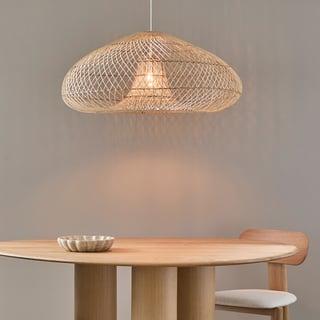 AM.PM · Titou, suspension rotin tresséthe centerpieceSee
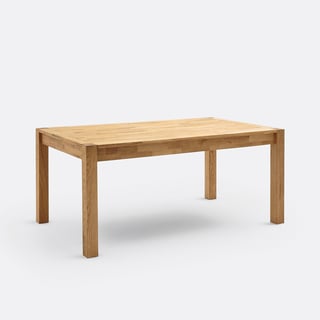 La Redoute Intérieurs · Adelita, table chêne extensiblethe table that lastsSee
- Made-in-Design · suspensions rotinthe beautiful one, designSee
- Habitat · Drio, table extensible chênethe affordable one, natural oakSee
Affiliate links · See our transparency →
And in your room — is this rule respected?
Photograph your room. The AI checks it against all 114 rules of the manual and returns the concrete fixes to apply this weekend.
Audit my roomFree, no sign-up. Analysed in under a minute.
The CRI, colour rendering index
The technical criterion everyone ignores, which changes everything
02.5The height of a pendant above a table
The 75 to 90 cm rule that changes the atmosphere of a meal
03.4The height of a dining table and its chairs
Thirty centimetres between seat and tabletop, never more, never less
One measured rule, every Tuesday.
Good measurements are worth keeping. Get The Bulletin: one décor rule explained in depth, Tuesday morning. Four minutes, zero noise.