Cushions, the odd-number rule
Three, five, seven cushions. Never two, four, or six
An even number of cushions looks frozen and symmetrical in the wrong way. Odd numbers give movement, breathing, life.

How many cushions should you put on a sofa?
Always count in odd numbers: 3 cushions on a two-seater, 5 on a three-seater, 7 on a large corner sofa. Even numbers freeze the look into a mirror, odd numbers give rhythm. Vary the sizes and fabrics, keep to 3 or 4 colours, and arrange them asymmetrically.
§ 01The principle
A composition of decorative objects in an odd number is almost always more dynamic than in an even number. This is an ancient principle observed in photography, painting, floral arrangement and interior design. Even numbers evoke frozen symmetry. Odd numbers evoke movement.
For cushions on a sofa: three cushions on a two-seater, five on a three-seater, seven on a large corner sofa. Never two or four, which create a "mirror" effect without rhythm.
To apply this rule: See selectionAffiliate

Two-seater: 3 cushions · Three-seater: 5 cushions · Large corner: 7 cushions
Always odd. Always asymmetric in arrangement.
§ 02Putting it into practice
Step 1: choose the number by sofa. Under 2 m, three cushions. Between 2 and 2.80 m, five. Over 2.80 m or for a corner, seven.
Step 2: vary the sizes. Three standard sizes to mix. Large (50 × 50 cm or 60 × 60 cm): basic format, placed back against the backrest. Count 2-3. Medium (40 × 40 cm or 45 × 45 cm): placed in front of large ones, as accents. Lumbar (30 × 50 cm rectangular): just one, placed centre or offset, gives the final rhythm.
Step 3: vary materials and colours. Mix at least two materials (linen, velvet, boucle) and two to three colours (all within the room's palette, see rule 01.1). Not all identical (frozen hotel effect), not all different (bric-a-brac effect).
Winning composition for five cushions on a three-seater. Two large off-white linen cushions at the ends, two medium teal velvet cushions in front, one central geometric pattern lumbar cushion. The eye travels naturally across the composition.
In small interiors. On a two-seater, three cushions are enough and do not overload. Avoid putting five cushions on a small sofa, the seating becomes unusable.
For the bed. The same rule applies to headboards: three cushions (on a standard double bed), five (on a king-size), mixing square and lumbar.
- 01Count in odd numbers: 3, 5 or 7 by sofa
- 02Vary sizes, materials, patterns
- 03Keep a coherent palette (3-4 colours max)
- 04Arrange in asymmetric composition
- 01Two identical cushions arranged symmetrically
- 02Four cushions of the same size in a row
- 03Five identical cushions (frozen hotel effect)
- 04Overloading a small sofa with seven cushions
§ 03Professional variations
Pierre Yovanovitch often works just three cushions, even on large sofas. Pared-back minimalist effect that lets the seat breathe. Requires very high-quality cushions (dense velvet, heavy linen).
India Mahdavi assumes seven to nine cushions on her large sofas, in varied materials and colours. Generous and theatrical effect.
A practical tip: swap cushion covers by season. Natural linen in summer, coloured velvet in winter. The sofa remains identical, the atmosphere changes. Cover brands: Caravane, Maison de Vacances, Bohemia Design.
Three, five or seven, never between.
---
For this rule
 AM.PM - Coussin lin lavé Elinathe beautiful one, natural linenSee
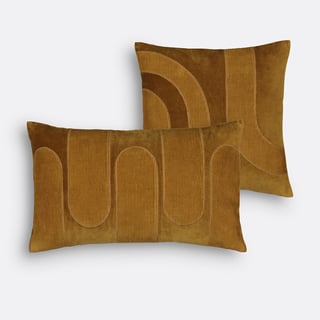 La Redoute - Coussin velours Brimothe affordable one, soft textureSee
 La Redoute - Coussin velours Velvetfor small budgetsSee
Affiliate links · See our transparency →
And in your room — is this rule respected?
Photograph your room. The AI checks it against all 114 rules of the manual and returns the concrete fixes to apply this weekend.
Audit my roomFree, no sign-up. Analysed in under a minute.
Triangular composition
Three objects at three different heights, the eye traces a triangle
07.7Trinkets grouped by material family
Three ceramics together are worth more than one ceramic, one book, one candle, one figurine
06.1Mix at least three textures per room
A room with only one material always feels cold, even with the right colours
One measured rule, every Tuesday.
Good measurements are worth keeping. Get The Bulletin: one décor rule explained in depth, Tuesday morning. Four minutes, zero noise.