The desk corner in the bedroom
When you have no choice, how to minimise the impact
Putting a desk in the bedroom is a bad idea. When you have no choice, here is how to limit the damage.
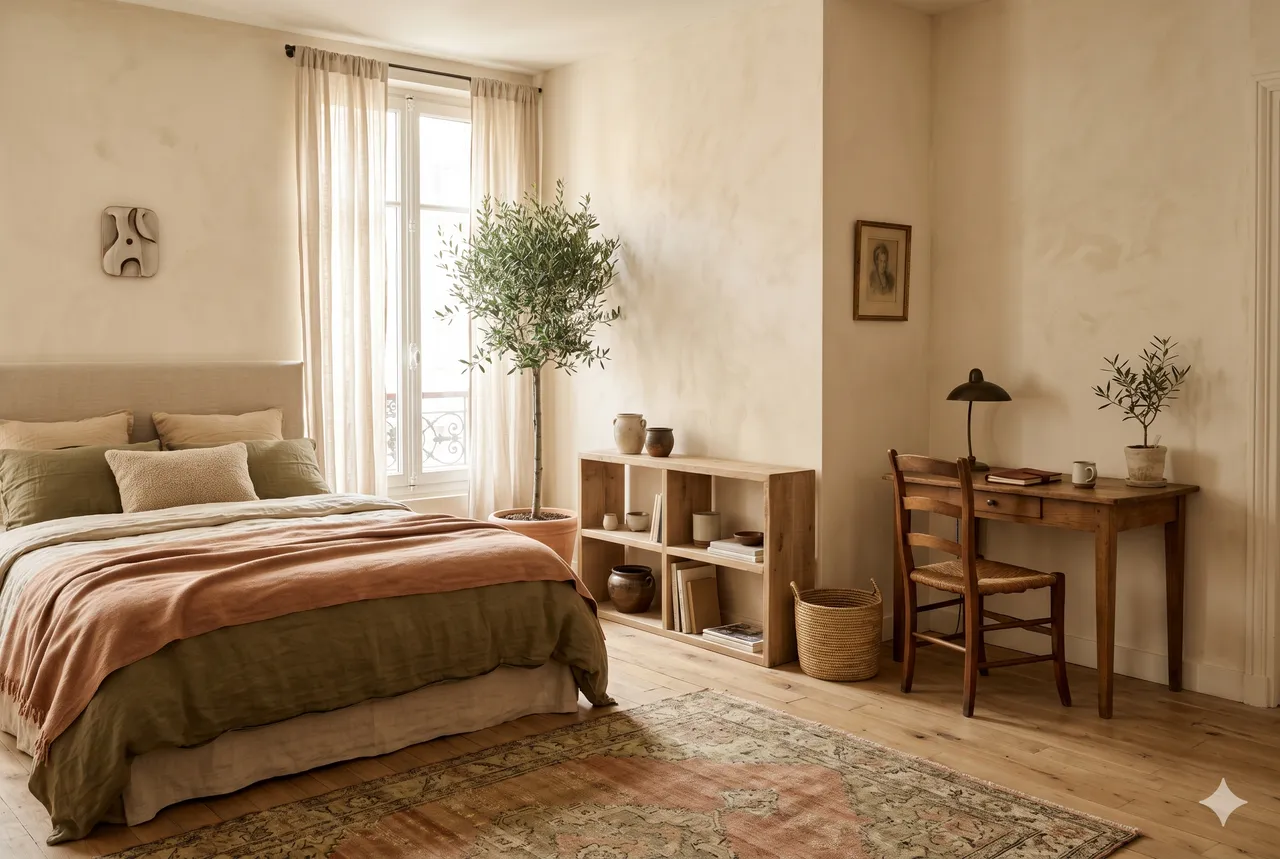
Putting a desk in the bedroom breaks the principles of sleep (see rule 08.6). No screen, no reminder of work in the rest zone. But sometimes, you have no choice. Four strategies to minimise the damage.
Strategy 1, physically separate the zones
Place the desk in the corner opposite the bed, ideally against a wall perpendicular to the headboard wall. The greater the physical distance between bed and desk, the better the mental separation works.
Ideal. A screen or curtain that visually separates the two zones at night.
Strategy 2, the "closable" desk
Choose a desk that closes (antique writing bureau, IKEA Hemnes bureau, or trunk-style desk like Bouroullec's). When closed, it is a simple piece of furniture, not a workstation.
Where to look. IKEA Hemnes bureau IKEA at £199. Flea market: vintage antique bureaux at Selency Selency or Le Bon Coin Le Bon Coin, £80-300.
A modern variant, a wall-mounted folding desk like the IKEA Norberg, which folds away completely.
Strategy 3, the end-of-day ritual
At a fixed time, the desk-closing ritual. Close the laptop, put the papers away, close the bureau (or draw a curtain), change the lighting (move from 4000K desk to 2700K bedroom).
This routine psychologically conditions the bedroom to become a rest zone again.
Strategy 4, two distinct lighting atmospheres
The desk has its own lighting (Tolomeo lamp Amazon, CRI 90+, 4000K for concentration during the day). When you switch it off in the evening, only the bedroom ambient lamps remain on (see rule 02.1).
Lighting becomes the visual marker between "desk mode" and "bedroom mode". A radical difference at bedtime.
What never works
- An open desk facing the bed (permanent reminder of work) - A computer screen visible from the bed - The bed used as an occasional desk (laptop on the sofa) - A permanent set-up with cables on show
## Key takeaways
If you must have the desk in the bedroom, close it up every evening and visually separate the two zones. The closing ritual is as important as the physical separation. The rule, the bedroom is a sleep sanctuary, the desk is a tolerated intruder.