How to read a paint chart like a pro
Decode the codes so you never get it wrong again
A paint chart is not a random list of colours. Decoding the codes will save you from mistakes.
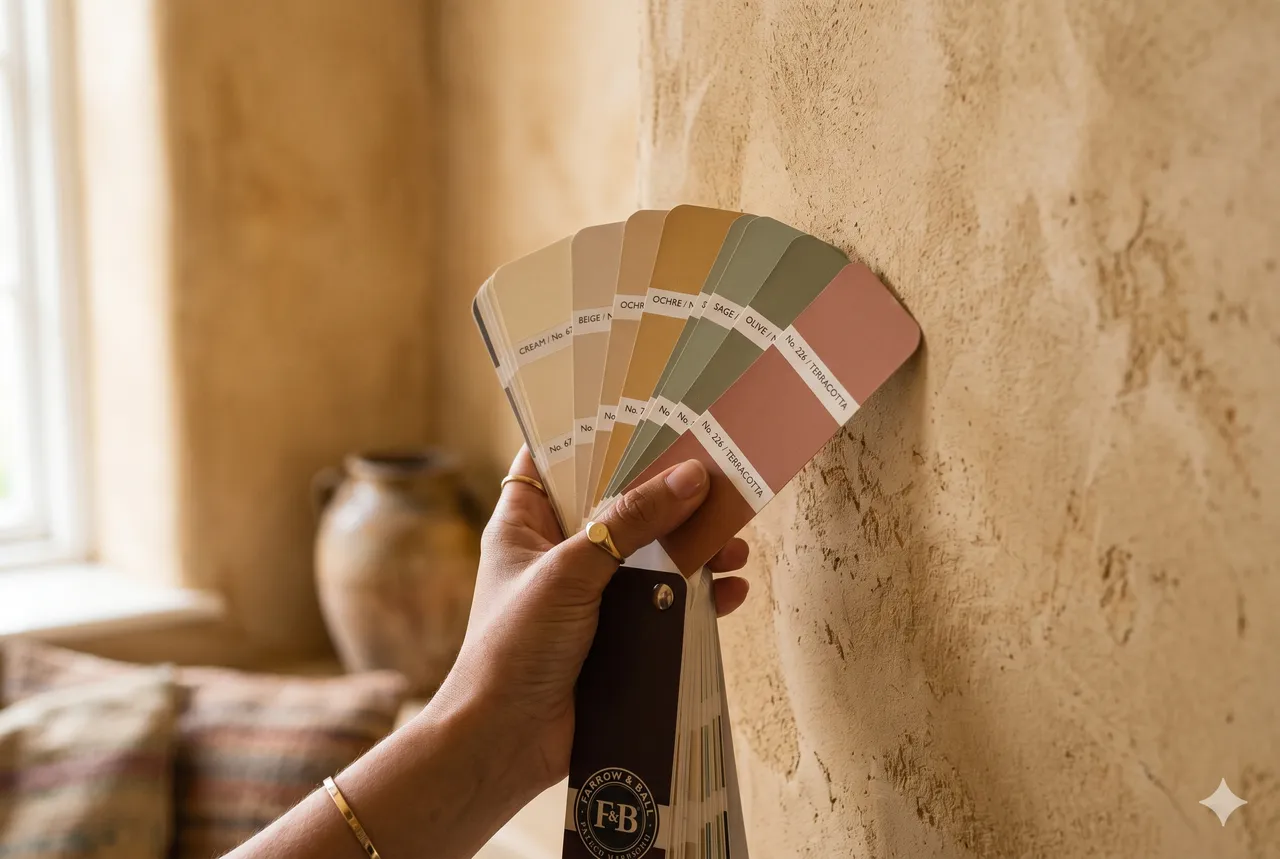
A paint chart (Farrow & Ball, Tollens, Argile, etc.) is not a random list. It has a logical organisation. Let's decode it.
1. Understand the "bands" of a paint chart
At Farrow & Ball for example, the 132 colours are organised into groups by undertone (the dominant pigment hidden beneath the apparent colour).
- Whites & Creams. Yellow, pink or beige undertones. - Greens & Blues. Grey-green, grey-blue undertones. - Pinks & Reds. Pink, terracotta undertones. - Yellows. Pure yellow undertones. - Neutrals. Grey or taupe undertones.
Important. A colour is never "neutral". It always has an undertone, identifiable by isolating it next to a pure white.
2. The LRV (Light Reflectance Value)
The LRV indicates how much light the paint reflects, on a scale of 0 (absolute black) to 100 (pure white). Very important for dark or bright rooms.
- LRV 70-90. Very light colour, reflects light. Ideal in a dark room. - LRV 40-70. Mid colour. Good compromise. - LRV 10-40. Dark colour, absorbs light. Ideal in a bright room or for a cocoon effect.
On a Farrow & Ball chart, the LRV is shown at the bottom of each swatch. On a RAL chart or another brand's chart, search for "Light Reflectance Value" in the online technical sheet.
3. Finishes and their effect
The same shade can be offered in several finishes, which radically change the look.
- Matt (Matt, Estate Emulsion). No sheen, absorbs light. More refined but shows wall imperfections. - Velvet (Velvet, Modern Emulsion). Very slight sheen. Washable. Ideal for living spaces. - Satin (Satin, Eggshell). Mid sheen. Very washable. Ideal for kitchen, bathroom, joinery. - Gloss (Gloss). Strong sheen. For joinery and woodwork only.
(See rule 01.7 for the detail of finishes by room).
4. Test before buying
Always buy a tester pot (100 ml, £5-8) before ordering 2.5 L (£50-80). Paint a large piece of card or a large sheet of paper (60×60 cm minimum), not just a small sample.
Test 48 h in the room. At different times of day, under artificial light. The same paint can look green in the morning and grey in the evening. (See rule 01.3).
5. Compare several brands
Three reference brands for residential.
- Farrow & Ball. The premium standard Farrow & Ball. £60-80 per 2.5 L. Exceptional pigmentation. - Little Greene. Top-end British equivalent Little Greene. £60-80 per 2.5 L. - Tollens. Accessible French equivalent Tollens. £35-55 per 2.5 L. Very good value. - Argile. French natural brand Argile. £50-70 per 2.5 L. Natural pigments.
Money-saving tip. Have a Farrow & Ball shade matched by a Tollens or Castorama store. 30% saving, very close result.
## Key takeaways
Undertone plus LRV plus finish = the three criteria that really define a colour. A paint chart reads like a book, not like a random sheet. The rule, always test 48 h in the room, always paint a large sample (see rule 01.3).