The odd-shaped wall, what to do
The step, the slope, the angled wall. Three concrete solutions
Every home has its 'odd wall'. Rather than trying to hide it, you embrace it or exploit it.
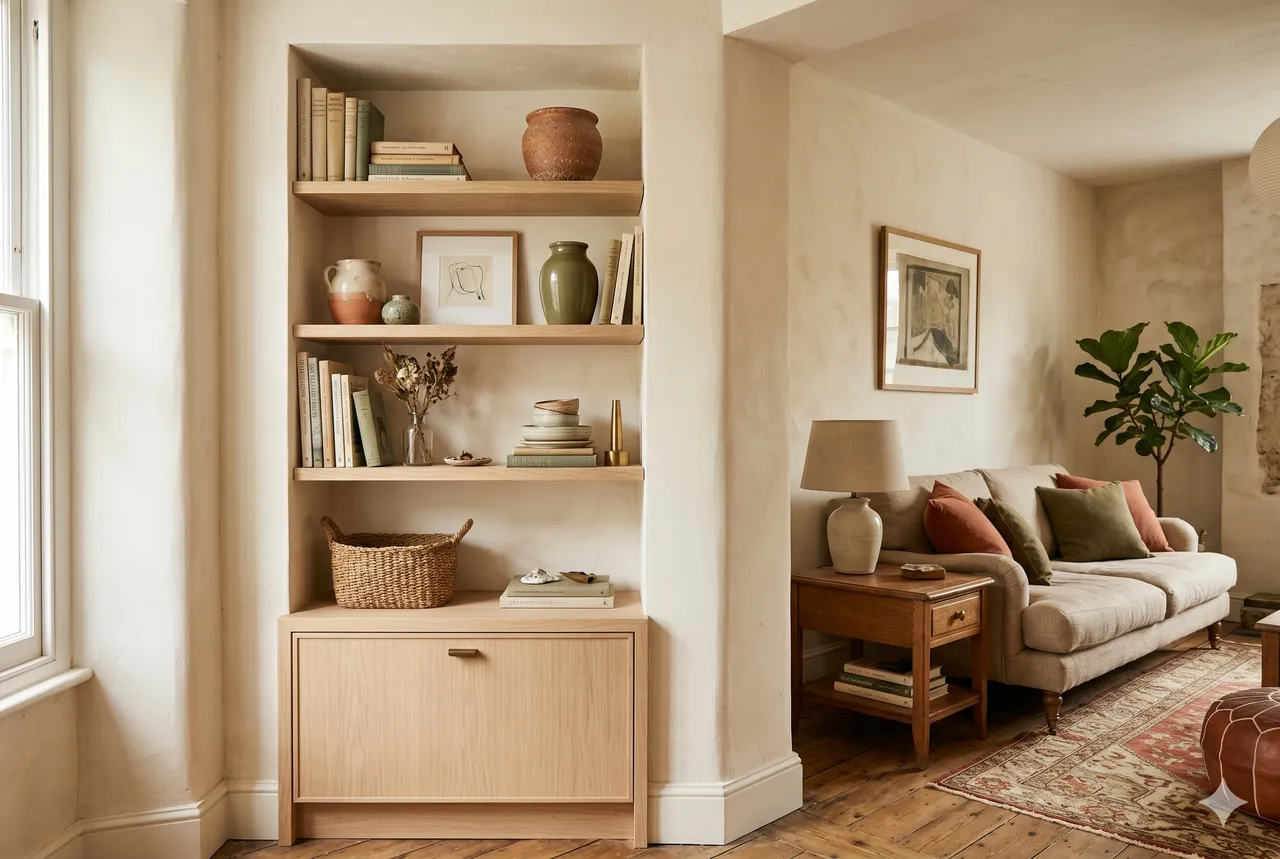
The step, the slope, the awkward angled wall. Most homes have their "architectural defect". Three strategies depending on the type.
Strategy 1, the vertical step (angled wall)
A wall that forms an awkward angle in the room. Often due to a services duct or a load-bearing wall that cannot be removed.
Solution, turn it into a niche. Create a niche painted in a different colour, or fit a bespoke bookcase in it, or hang a panel artwork. The step becomes an intentional feature.
Cost. Paint alone, £30. Niche with shelving, £80-200 with an IKEA Lack install or similar.
Strategy 2, the sloped ceiling (loft conversion)
Very common in lofts and attic conversions. The ceiling drops on one side of the room.
Main solution, exploit the slope as low storage. Bench with built-in chests, fitted desk, bed placed directly under the slope.
What you'll need. Bespoke joinery by a carpenter (£300-800 depending on dimensions), or low off-the-shelf furniture from Tikamoon Tikamoon.
Paint tip. Painting the slope and the wall in continuity (same shade) creates an enveloping "vault" effect, instead of a "crushing" one.
Strategy 3, the recessed wall (alcove)
A recess created by a chimney breast, a closed cupboard, or a load-bearing wall. Often 60-90 cm deep.
Solution, exploit it as a built-in bookcase or as a bed alcove. The recess disappears by becoming functional.
Cost. IKEA Pax system IKEA adapted as a bookcase (£300-600). Alcove bed, bespoke by a joiner (£800-1,500).
The golden rule, embrace rather than hide
The classic mistake, trying to "correct" an odd-shaped wall by putting a straight piece of furniture in it, which then looks wonky against the angled wall. On the contrary, echo the geometry of the wall with a bespoke piece or paintwork that highlights the shape.
Another option, embraced contrast. If the wall is angled, the furniture is strict. The contrast makes the odd geometry interesting rather than annoying.
## Key takeaways
An odd wall is a defect if you put up with it, a signature if you exploit it. The rule, adapt the furniture to the wall, not the other way around, and use paint to highlight, not to camouflage.